Approached through the history of art, the marine landscape is envisioned as a symbol of, eg, vastness, spirituality, the sublime, and the journey of human life. It is something for the human gaze and imagination —an anthropocentric promise of excitement and struggle, too. The calm and the chaos. We, humans, tend to categorize the elements of a landscape as compositional surfaces: a field, a forest, a river, a coast, the sea, and so forth. Through the natural sciences, it is evident, then again, that this classification is not that simple, or at least that it is wrong to think of them as separate entities. For example, 98% of streamwater flows from/through the land, filtered and affected by the soil substances that carry it, while only 2% comes from precipitation. In the Baltic Sea, 30–40 % of the water comes from these streams.
Thinking about art, symbolism, and human perception, this ‘leakiness of the landscapes’ raises intriguing implications. It becomes relatively quickly impossible to keep these entities intellectually separate, but human perception still resists, wanting clean categories and objects of aesthetic sensibility. Reality is perhaps too messy, too complicated, and acknowledging that demands too much from us. We want to rely on what we see most of all. Rely on our senses, and the dominant visual sense in particular. Strong forces such as evolutionary biology are at play here. It is more complex to form a relation with a systemic entity than it is with an object with clear borders.
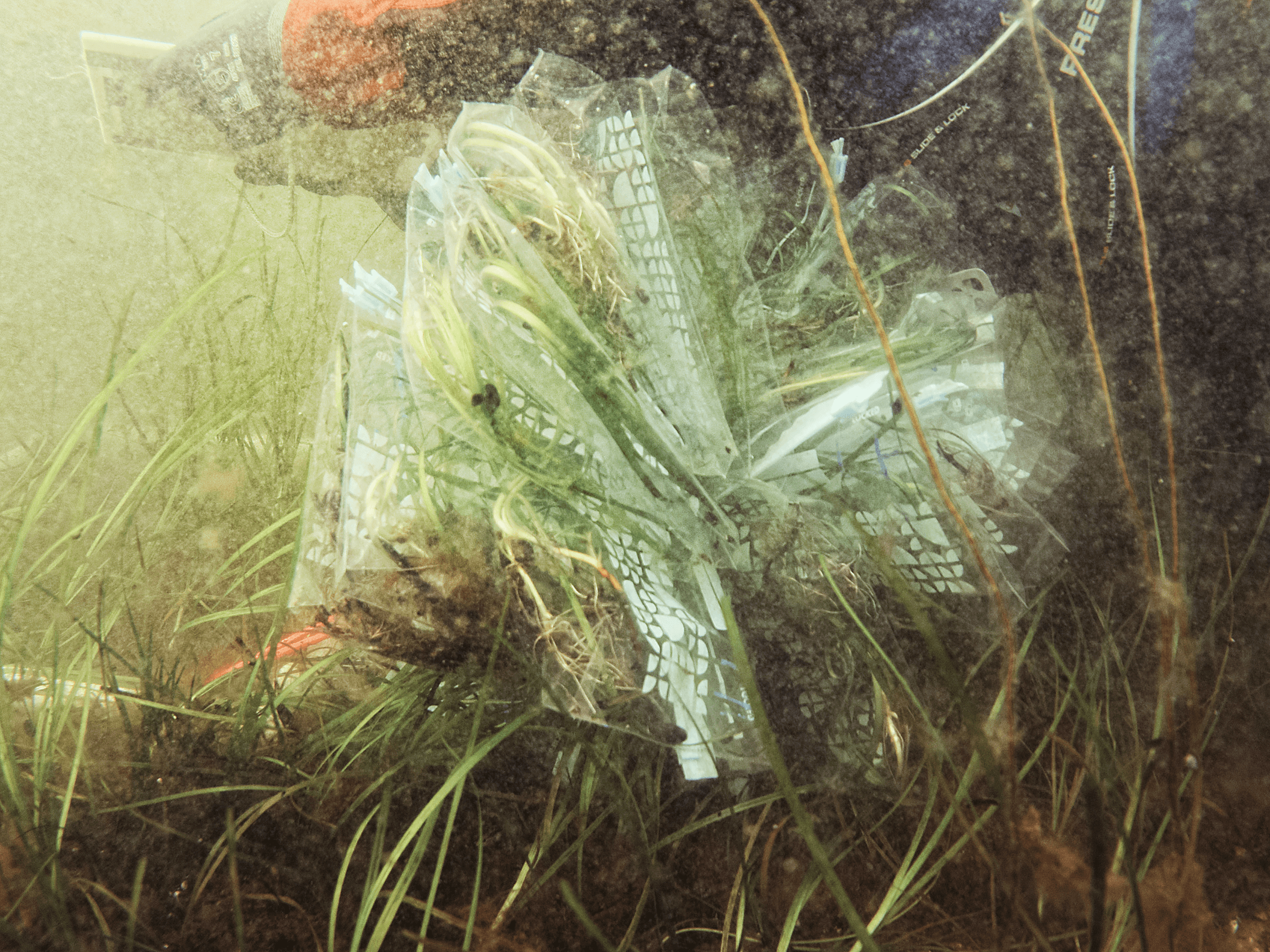
In the project, Teemu Lehmusruusu follows the soil from the fields and forests to the benthic Baltic. Collaborating with marine biologists studying the rapidly changing ecological conditions of the keystone eelgrass meadows on the Finnish coast, he uses installations and moving image to explore the soil-sea continuum in multisensory ways.
In collaboration with the Korpoström Archipelago Center residency program, hosted by Pro Artibus, and the SOS – Center for Sustainable Ocean Science at Åbo Akademi. Teemu Lehmusruusu completed the Foundations for Scientific Diving certificate with the Finnish Scientific Diving Academy at the Tvärminne Zoological Station.